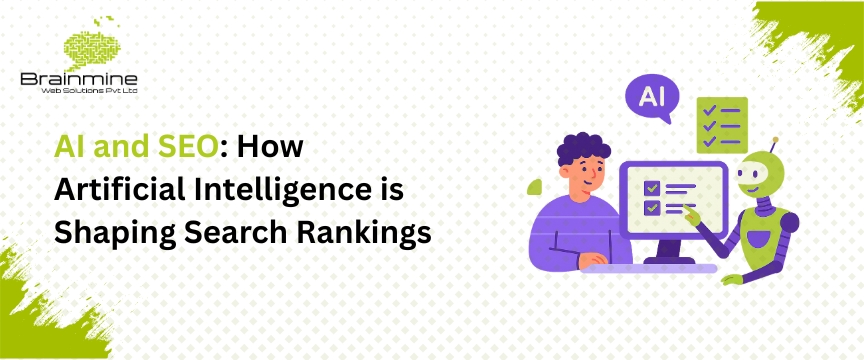
The digital marketing landscape has undergone a seismic shift in the last few years, and Artificial Intelligence is at the epicentre of this transformation. From how search engines evaluate content to how brands craft their performance marketing strategies, AI is no longer a futuristic buzzword — it is the present reality driving every algorithm update, ranking signal, and user experience decision made by Google, Bing, and other major search engines.
For businesses investing in digital marketing services, understanding how AI intersects with SEO is no longer optional. It is the difference between dominating search rankings and being invisible online. Whether you are a startup trying to get discovered or an established enterprise aiming to protect your organic traffic, the rules of the game have fundamentally changed — and AI is writing those rules.
In this blog, we take a deep dive into how AI is reshaping search rankings, what it means for your SEO strategy, and why partnering with the right experts can make all the difference.
The Rise of AI in Search Engines: A New Era of Understanding
Search engines have traditionally relied on keyword matching and backlink analysis to determine rankings. But with the introduction of AI-powered algorithms, search engines have evolved from simple indexers to sophisticated intent-interpreters.
Google’s introduction of RankBrain in 2015 was the first public acknowledgement that machine learning was influencing search results. Since then, BERT (Bidirectional Encoder Representations from Transformers) and MUM (Multitask Unified Model) have taken this further, enabling Google to understand the nuance, context, and emotion behind a user’s query — not just the literal words typed.
What this means practically is profound. A user searching for “best shoes for rainy weather Mumbai” is not just looking for shoes — they are looking for footwear that handles wet pavements, is available locally, and suits the monsoon climate. AI allows Google to decode that layered intent and serve results that genuinely answer the question. For businesses offering digital marketing services, this means keyword stuffing and shallow content are definitively dead. AI rewards depth, relevance, and genuine value.
AI-Powered Content Creation and Optimisation
One of the most direct ways AI impacts SEO is through content creation and optimisation. AI writing assistants, semantic analysis tools, and content scoring platforms have transformed how SEO professionals approach on-page optimisation.
Tools powered by natural language processing (NLP) can now analyse top-ranking pages, identify semantic gaps in your content, suggest related topics, and even recommend optimal content length — all in real time. This level of precision was previously impossible without weeks of manual research.
However, there is a critical nuance here. While AI can assist in content creation, Google’s E-E-A-T framework (Experience, Expertise, Authoritativeness, Trustworthiness) strongly prioritises human-led, experience-backed content. This means businesses must use AI as a productivity amplifier, not a replacement for genuine expertise. The brands winning in search rankings today are those combining AI efficiency with authentic human insight — a balance that professional digital marketing services are uniquely positioned to deliver.
For performance marketing campaigns, AI-driven content optimisation also directly influences Quality Scores in paid search, reducing cost-per-click while improving ad relevance. The synergy between organic SEO and paid performance marketing has never been tighter.
AI and Technical SEO: Smarter Crawling, Faster Indexing
Technical SEO — the behind-the-scenes architecture that makes your website readable to search engines — has also been transformed by AI. Google’s crawlers now use machine learning to prioritise which pages to crawl and index, based on signals like page quality, update frequency, and relevance to user queries.
Core Web Vitals, the set of performance metrics Google uses to evaluate page experience, are now algorithmically weighted using AI models that interpret real-user data at scale. This means your site’s loading speed, interactivity, and visual stability are no longer just technical concerns — they are direct ranking factors evaluated through an AI lens.
AI tools like automated site auditing platforms can now detect crawl errors, identify duplicate content, map internal linking opportunities, and even predict which technical fixes will have the most impact on rankings. For businesses relying on digital marketing services to grow their online presence, leveraging these AI-powered technical SEO tools is a non-negotiable part of any modern strategy.
Personalisation and AI: How Search Results Are No Longer Universal
One of the most profound changes AI has introduced to SEO is personalisation. Search results are no longer the same for every user. AI analyses hundreds of signals — location, device, search history, browsing behaviour, time of day — to serve a personalised set of results for every individual query.
This has major implications for businesses. Your ranking position is not a fixed number anymore. It fluctuates based on who is searching, when, and from where. For a business in Mumbai, local SEO has become inseparable from AI-driven personalisation. Google’s local ranking algorithm uses AI to factor in proximity, prominence, and relevance — meaning your Google Business Profile, local citations, and review signals are being processed by machine learning models every time a local query is made.
This is where professional digital marketing services with deep expertise in local SEO become invaluable. Understanding how AI personalises results for Mumbai-based audiences requires hyper-local knowledge combined with technical SEO expertise — a combination that generic DIY tools simply cannot replicate.
Voice Search, AI Assistants, and Conversational SEO
The rise of voice search — powered by AI assistants like Google Assistant, Siri, and Alexa — has introduced an entirely new dimension to SEO strategy. Voice queries are longer, more conversational, and typically framed as full questions. “What is the best digital marketing agency near me?” is structurally very different from typing “digital marketing agency Mumbai” into a search bar.
AI processes these conversational queries using the same NLP models powering written search, but the ranking patterns differ. Featured snippets, People Also Ask boxes, and zero-click results dominate voice search outcomes. Optimising for these positions requires structuring content in a question-and-answer format, using schema markup, and providing direct, concise answers early in your content.
For performance marketing, voice search data also reveals high-intent consumer behaviour patterns that can be fed back into paid campaign targeting — making AI a bridge between organic and paid channels in ways that significantly enhance ROI.
AI in Link Building and Authority Signals
Link building — the process of acquiring backlinks from authoritative websites — has long been a cornerstone of SEO. AI has made this both more sophisticated and more scrutinised. Google’s spam detection systems, powered by machine learning, have become extraordinarily adept at identifying manipulative link schemes, private blog networks (PBNs), and low-quality paid links.
At the same time, AI tools are now helping SEO professionals identify genuine link-building opportunities by analysing competitor backlink profiles, predicting which outreach targets are most likely to respond, and scoring the authority and relevance of potential linking domains with remarkable accuracy.
For brands serious about building long-term search authority, this means investing in earned media, digital PR, and content that naturally attracts links — all supported by AI-driven prospecting and outreach tools. This is the kind of strategic, data-backed approach that distinguishes elite digital marketing services from commodity providers.
Predictive Analytics and AI-Driven SEO Strategy
Perhaps the most exciting frontier of AI in SEO is predictive analytics — using machine learning models to forecast ranking opportunities, anticipate algorithm shifts, and identify emerging search trends before they peak. Rather than reacting to changes after they happen, AI enables proactive, forward-looking strategy.
Platforms leveraging predictive AI can now identify which keywords are gaining momentum months in advance, forecast which content topics will trend based on cultural and behavioural signals, and even model the likely traffic impact of specific optimisation decisions before they are implemented. This transforms SEO from an iterative trial-and-error process into a precision-engineered growth channel.
For businesses combining SEO with performance marketing, predictive analytics creates a powerful feedback loop. Paid search data reveals what converts; organic search reveals what attracts. AI synthesises both streams to build strategies that are simultaneously high-traffic and high-conversion — the ultimate goal of integrated digital marketing services.
The Future: AI Overviews, SGE, and What Comes Next
Google’s Search Generative Experience (SGE) and the rollout of AI Overviews represent the next major disruption in search. These features use large language models to generate synthesised answers directly in the search results page — often before a user ever clicks through to a website.
This is both a challenge and an opportunity. Brands whose content is sourced by Google’s AI summaries gain unprecedented visibility and authority signals. Those who are not cited risk significant traffic declines as zero-click searches increase. Optimising for AI Overviews requires building comprehensive, authoritative, well-structured content that AI models can confidently cite — raising the bar for content quality across every industry.
Staying ahead of these shifts requires constant learning, strategic agility, and deep technical expertise — precisely what a specialist SEO partner brings to the table.
Conclusion
Artificial Intelligence has irreversibly changed the way search engines rank websites and the way businesses must approach digital marketing services. From intelligent content optimisation and personalised search results to predictive analytics and AI-generated search overviews, every dimension of SEO is now AI-influenced.
The businesses that will thrive in this new landscape are those who embrace AI as a strategic ally — combining machine learning efficiency with human creativity, local expertise, and a relentless commitment to delivering genuine value to their audience.
🚀 Ready to Dominate Search Rankings with AI-Powered SEO?
Partner with the experts who understand both the technology and the market.
At SEO Company in Mumbai – Brainmine Web Solution, we combine cutting-edge AI tools with deep expertise in SEO, performance marketing, and digital marketing services to deliver measurable, sustainable growth for businesses across Mumbai and beyond. Whether you need a full-scale SEO audit, a performance marketing strategy, or end-to-end digital marketing services, our team is ready to help you rank higher, attract more customers, and grow faster.
Frequently Asked Questions (FAQs)
How is AI changing SEO in 2025 and beyond?
AI is fundamentally transforming SEO by enabling search engines to understand user intent at a much deeper level. Algorithms like Google’s BERT and MUM use natural language processing to interpret the context and nuance of search queries — not just keywords. This means SEO strategies must now focus on topical authority, content depth, E-E-A-T signals, and genuine user value rather than traditional keyword density. AI is also powering predictive analytics, personalised search results, and new features like AI Overviews that are reshaping how organic traffic is distributed.
What is the role of AI in digital marketing services?
AI plays a central role across all disciplines of digital marketing services — from SEO and content creation to paid advertising, email marketing, and conversion rate optimisation. In SEO specifically, AI tools assist with keyword research, semantic content optimisation, technical site auditing, backlink analysis, and performance forecasting. In performance marketing, AI automates bidding strategies, audience segmentation, and ad creative testing. The overall impact is faster execution, more precise targeting, and significantly improved ROI for marketing campaigns.
Does AI-generated content rank on Google?
AI-generated content can rank on Google if it meets the standards of quality, accuracy, and E-E-A-T (Experience, Expertise, Authoritativeness, Trustworthiness). Google’s official stance is that it evaluates content based on quality — not how it was produced. However, purely AI-generated content that lacks original insights, factual accuracy, or human expertise tends to underperform. The best-performing content combines AI efficiency with human editorial oversight, ensuring depth, authenticity, and genuine value for the reader.
How does AI affect local SEO for businesses in Mumbai?
AI personalises search results based on location, user behaviour, and contextual signals — making local SEO more important and more complex than ever. For Mumbai businesses, AI-driven local search factors include Google Business Profile completeness, local citation consistency, review quality and volume, proximity signals, and mobile-first performance. Google’s local ranking algorithm uses machine learning to weigh these factors dynamically, meaning businesses with optimised local profiles and strong review signals gain a significant competitive advantage in Mumbai’s dense digital marketplace.
What is performance marketing and how does AI improve it?
Performance marketing refers to digital advertising strategies where businesses pay for specific outcomes — clicks, leads, conversions, or sales — rather than impressions. AI enhances performance marketing by automating bid management (Smart Bidding in Google Ads), optimising audience targeting through predictive modelling, personalising ad creative at scale, and identifying high-converting keyword and audience segments in real time. AI also enables cross-channel attribution, helping marketers understand exactly which touchpoints are driving conversions — allowing budgets to be allocated with surgical precision.
What is Google’s E-E-A-T and why does it matter for SEO?
E-E-A-T stands for Experience, Expertise, Authoritativeness, and Trustworthiness — the framework Google’s quality raters use to evaluate web content. AI has made E-E-A-T signals more important because machine learning models can now identify and reward content that demonstrates genuine first-hand experience, subject matter expertise, and credibility signals like author bios, citations, and editorial standards. For businesses investing in SEO, building E-E-A-T means publishing well-researched, author-attributed content, earning high-quality backlinks, maintaining accurate business information, and actively managing online reputation.
What are AI Overviews and how should businesses optimise for them?
AI Overviews (formerly part of Google’s Search Generative Experience) are AI-generated summaries that appear at the top of search results for many queries, synthesising information from multiple sources. To optimise for AI Overviews, businesses should create comprehensive, well-structured content that directly answers common questions in their niche, implement schema markup (particularly FAQ and HowTo schemas), build topical authority across a content cluster, and ensure their website is technically sound and fast-loading. Being cited in AI Overviews signals strong authority and can drive brand awareness even in a zero-click search environment.
Why should I hire a professional SEO company instead of using AI tools myself?
While AI tools have made many SEO tasks more accessible, effectively leveraging them still requires deep expertise in search algorithms, content strategy, technical SEO, and competitive analysis. A professional SEO company like Brainmine Web Solution brings not just the tools, but the strategic intelligence to interpret AI-generated insights and translate them into impactful actions. We understand the nuances of the Mumbai market, monitor algorithm updates in real time, and build integrated strategies that combine SEO with performance marketing for holistic digital growth. AI tools are only as powerful as the strategy and expertise behind them.