




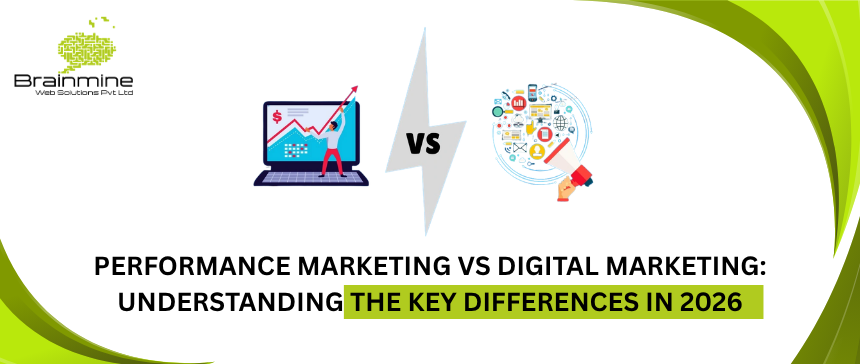
When a business owner asks for digital marketing and receives a social media content calendar, or asks for performance marketing and gets a basic Google Ads account without conversion tracking, the confusion usually starts with terminology. Performance marketing and digital marketing are related but not interchangeable, and building a strategy on a misunderstanding of the difference leads to misaligned expectations, misallocated budgets, and a recurring frustration that marketing spend is not producing the commercial outcomes the business actually needs.
Getting this distinction clear is not a semantic exercise. It is a practical prerequisite for making good decisions about where to invest, what to measure, and what to expect from a performance marketing agency in india or a broader digital marketing engagement.
What Digital Marketing Is
Digital marketing is the full scope of promotional activity conducted through digital channels. It includes search engine optimisation, paid search advertising, social media marketing, content marketing, email marketing, display advertising, influencer partnerships, affiliate marketing, video marketing, and performance marketing. The term describes a category, not a specific methodology.
Not all digital marketing is held to the same standard of commercial accountability. A brand awareness campaign on YouTube that measures success in views and reach is digital marketing. An SEO programme that measures success in organic lead volume is also digital marketing. A social media strategy that measures success in follower growth and engagement rate is digital marketing too. The outputs and accountability frameworks differ significantly across these disciplines even though they all operate under the digital marketing umbrella.
What Performance Marketing Is
Performance marketing is a specific subset of digital marketing defined by one distinguishing principle: spend is directly tied to a measurable, commercial outcome. The advertiser pays when a defined action occurs, not simply for visibility or impressions. That action might be a click, a lead form submission, a phone call, a purchase, an app installation, or any other conversion event that the business has defined as commercially meaningful.
The commercial intent behind every performance marketing campaign is explicit from the outset. A performance marketing agency in india working with a B2B client defines the target action, the acceptable cost per action, and the volume required before building any campaign. Budget allocation, bidding strategy, creative approach, and audience targeting are all subordinated to that conversion objective.
This accountability structure is what distinguishes performance marketing from broader digital marketing. It makes the commercial relationship between spend and outcome direct and measurable in a way that brand awareness, organic social, or content marketing programmes are not always designed to produce.
Where They Overlap
The channels used in performance marketing are a subset of the channels available across digital marketing. Google Ads, Meta Ads, LinkedIn Ads, and programmatic display can all be run as performance marketing campaigns when they are structured around conversion objectives and measured against cost per acquisition. The same channels can also be used for brand awareness objectives that are not performance-oriented.
Content marketing, produced primarily as an organic SEO asset, frequently becomes performance marketing fuel when it is repurposed as a paid social creative or a landing page for a Google Ads campaign. The disciplines are not rigidly separated in practice. What separates them is the accountability framework applied, not the channels used.
The Key Practical Differences
Measurement and Accountability
Performance marketing is measured against cost per lead, cost per acquisition, return on ad spend, or another commercial KPI defined at the outset. Every rupee of spend is evaluated against its contribution to that outcome. Campaigns that produce results at or below the target cost per action are scaled. Those that do not are paused, restructured, or replaced.
Broader digital marketing, particularly brand awareness and organic channels, operates on longer feedback loops and different success metrics. SEO is measured in ranking positions and organic traffic trends over months. Social media brand building is measured in audience growth, engagement quality, and share of voice. Neither is less valid than performance marketing, but neither provides the direct spend-to-outcome accountability that performance marketing is specifically designed to deliver.
Timeline to Results
Performance marketing generates results immediately. A well-structured Google Ads campaign produces clicks and conversion data from day one. Meta campaigns reach target audiences within hours of launch. This immediacy is a genuine commercial advantage for businesses that need qualified leads now, are launching a new product, or are entering a new market and cannot wait months for organic channels to build.
Organic digital marketing disciplines like SEO and content marketing operate on timelines measured in months. The trade-off is that once they are established, they generate compounding returns that do not stop when the budget is paused. Performance marketing generates returns proportional to ongoing spend. The moment the budget stops, the results stop with it.
Cost Structure
Performance marketing costs are variable and directly tied to campaign activity. A business spending Rs. 1 lakh per month on Google Ads generates traffic and leads proportional to that spend. Increasing or decreasing the budget produces a proportional change in output, subject to the efficiency of the campaign.
Organic digital marketing has a different cost structure: significant upfront investment in content, technical work, and authority building that produces diminishing marginal cost over time as the asset compounds. The total cost of customer acquisition through organic channels typically falls as the programme matures, while performance marketing cost per acquisition tends to rise over time as competition increases and audience saturation grows.
Which Does Your Business Need?
For most established businesses with a medium to long time horizon, the answer is both, with different emphasis depending on the specific commercial context and where the business currently stands digitally.
A business launching a new product needs immediate visibility that only performance marketing can provide, while beginning organic programmes in the background. A business with established organic rankings that generate consistent pipeline may find that performance marketing adds volume during peak demand periods without being the primary lead source. A business with no digital presence needs to assess whether immediate paid lead volume or longer-term organic authority is the higher priority given its available budget.
A performance marketing agency in india that understands both disciplines will be honest about which one produces the most commercial value for a specific business at a specific point in time, rather than defaulting to recommending the service it is most comfortable selling.
What to Look for in a Performance Marketing Partner
The indicators of genuine performance marketing capability are operational, not promotional. A capable performance marketing agency in india tracks cost per qualified opportunity rather than just cost per lead. It builds measurement infrastructure that connects ad platform data to CRM outcomes. It runs incrementality tests to verify that campaigns are producing conversions that would not have happened through other channels. And it reports honestly on what is working and what is not, because that honesty is what enables the budget decisions that improve programme efficiency over time.
Want to understand which combination of performance marketing and digital marketing is right for your business right now? Talk to Our Team