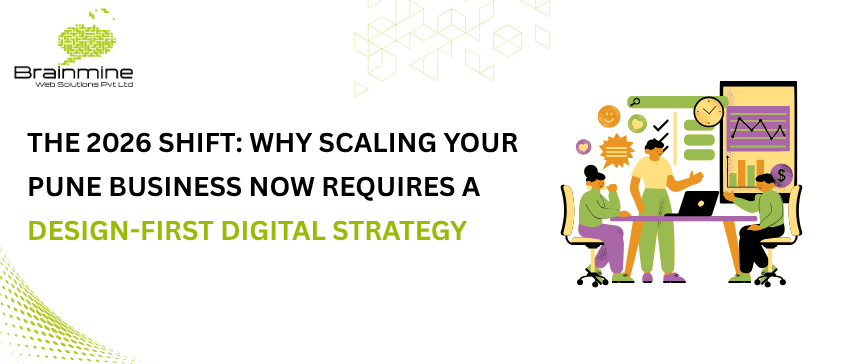
There’s a quiet but significant shift happening across Pune’s commercial landscape right now. Startups in Kothrud are refreshing their entire brand presence. Mid-sized manufacturers in Pimpri-Chinchwad are finally taking their websites seriously. Retail businesses in Baner are spending real money on digital — not just because they want to, but because they’ve realised they have to. If you’ve been putting off a digital overhaul, the timing matters more than you think. Not because of some arbitrary deadline, but because the gap between businesses with a coherent digital presence and those without is widening faster than before.
Why 2026 Is Different From Every Year You’ve Heard This Before
The usual argument for going digital was about reaching more customers. That’s still true, but it’s no longer the most urgent reason. Three things have converged in a way they haven’t before. First, AI-driven search is changing how people find businesses — they’re asking questions and getting direct answers instead of clicking through ten blue links. Second, mobile-first behaviour isn’t just about screen size anymore; it’s about how quickly someone decides whether your brand is worth their attention. Third, design quality has become a genuine trust signal.
Visitors don’t articulate it this way, but they make a snap judgment about your credibility based on how your website looks within seconds of landing on it. A cluttered layout, outdated typography, or confusing navigation communicates something you didn’t intend to say.
What ‘Design-First’ Actually Means (It’s Not Just Aesthetics)
There’s a misconception that design is a surface-level concern — something you deal with after the ‘real’ business decisions are made. That framing tends to produce websites that look like they were built that way.
A design-first approach starts with intent. Before any colour palette is chosen or pixel placed, the questions being asked are: Who is the user? What action do we want them to take? What’s standing in their way? The visual execution comes after that clarity is established. This is why working with experienced design companies in Pune changes the outcome of a project. It’s not that external agencies have better taste. It’s that they bring a process that separates problem definition from solution execution — something that’s hard to maintain when you’re also running the business. For Pune businesses specifically, this matters because the city’s market is both local and increasingly pan-Indian. A bakery in Aundh might be selling to corporate clients across Maharashtra. An IT firm in Hinjewadi might be pitching to clients in Europe. Your digital presence has to work across all those contexts simultaneously.
The Baner Advantage: Why Location Still Matters in Digital
Baner has developed into one of Pune’s more commercially dense corridors. The mix of residential high-rises, co-working spaces, and established businesses creates a particular kind of competitive environment — one where word-of-mouth travels quickly and digital first impressions carry real weight.
Businesses in this area tend to have a certain profile: they’ve been around long enough to have a customer base, but they’re also surrounded by newer competitors who have built their digital presence from scratch. That’s not a comfortable position to be in if your own website hasn’t been touched in three years.
A digital marketing agency in Baner understands this local context. The audience behaviours, the competitive landscape, the kind of messaging that resonates — these are not things you learn from a generic industry report. They come from working within a specific geography over time.
Where Businesses Are Actually Getting This Wrong
The most common mistake isn’t neglecting digital entirely — it’s treating different digital touchpoints as separate projects. A new website gets built, but no one has thought about how it connects to the content strategy. Social media is handled by someone in-house, but there’s no link between what’s posted and what the website is designed to convert. The result is a patchwork digital presence that sends mixed signals. A potential customer might find you through a well-run Instagram account, land on a website that feels like a different brand entirely, and leave without doing anything.
Consistency is the word that comes up again and again when you talk to businesses that have genuinely grown through digital. Not uniformity — there’s a difference. Uniformity is using the same logo everywhere. Consistency is making sure every touchpoint reinforces the same core message about who you are and why someone should choose you.
Practical First Steps for Pune Businesses in 2026
If you’re not sure where to start, these are the areas worth examining first.
• Audit your existing website for mobile performance and load speed — these directly affect search rankings and user behaviour.
• Map your customer journey from first contact to conversion and identify where people drop off.
• Evaluate whether your brand visuals still reflect how your business has evolved — a logo designed in 2015 for a five-person team might not serve a thirty-person company today.
• Look at competitors who are visibly growing and try to understand what their digital strategy has in common.
None of this requires a massive budget upfront. It requires clarity about where the gaps are, which is exactly what a structured conversation with a digital partner should help you arrive at.
The Cost of Waiting
Here’s the honest part. Digital strategy is not like repainting your office — something you can put off indefinitely without consequence. Every month your competitor’s website is better than yours, they’re building a small advantage. Those small advantages compound.
The businesses that tend to regret not moving faster are the ones that waited until something went visibly wrong — a major competitor launched, an algorithm update hit their traffic, a product launch underperformed because there was no proper digital infrastructure to support it. By the time the urgency is obvious, the gap is already substantial.
Final Thought
Pune’s business environment is genuinely competitive, and it rewards clarity. Knowing what your brand stands for, communicating it consistently across every digital touchpoint, and backing it with a user experience that makes action easy — that combination is what a design-first digital strategy actually delivers.
The shift isn’t just happening. For many Pune businesses, it has already happened. The question is whether you’re positioned on the right side of it.