Why Email Is Still the Highest ROI Channel and How AI Is Amplifying That Advantage
Every few years, a new channel generates enough attention that marketing teams begin questioning whether email is losing its relevance. Social media was going to replace it. Push notifications were going to make it obsolete. Messaging apps were going to render it redundant. In 2026, email is generating between $36 and $45 for every $1 invested — a return that is nearly 10 times what social media delivers on a comparable spend basis.
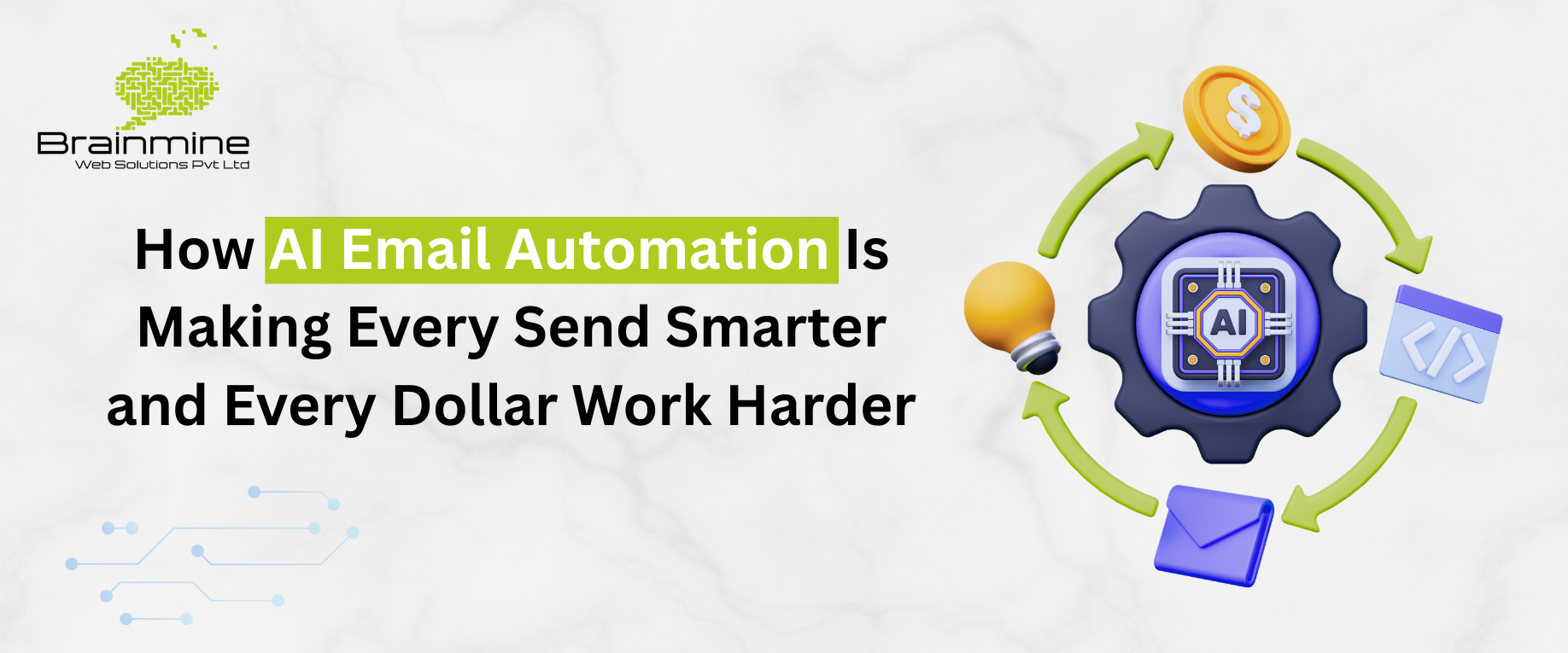
The channel is not in decline. It is in transformation. And the transformation is specifically about the intelligence applied to every send decision. AI email automation has changed email from a broadcast medium — where a marketing team decides what to send, builds the asset, and deploys it to a list — into a personalized revenue channel where every message is the product of real-time behavioral data, individual preference modeling, and predictive timing logic.
The teams that are capturing email’s full ROI potential in 2026 are not the ones with the most sophisticated templates or the largest lists. They are the teams running AI email automation infrastructure that decides, individually and continuously, what each subscriber should receive, in what format, at what time, through what device, and — critically — whether to send at all. That last capability is one of the most underappreciated dimensions of what email marketing AI has introduced: the intelligent choice not to send.
The Death of Batch and Blast and What Replaced It
Batch-and-blast email — the practice of sending the same message to the entire list on a fixed schedule — was never actually effective. It was simply the only operationally feasible approach available to teams working without AI. Segmentation improved it marginally. A/B testing improved it incrementally. But the fundamental model — send the same thing to a large number of people and measure aggregate results — was always a compromise.
AI email automation replaces this model entirely. Every send decision — who receives this message, at what time, in what subject line variant, with what content block order, optimized for what device — is made individually, based on that specific subscriber’s behavioral profile and engagement history. The list is not treated as a single audience. It is treated as thousands of audiences of one.
The AI functions as what practitioners call the Invisible Engine behind every campaign. It is not just selecting the best subject line from a test set. It is generating dynamic subject lines calibrated to individual open history. It is determining that subscriber A is most likely to engage at 7 AM on Tuesday, while subscriber B consistently opens during their commute on Thursday evenings. It is identifying that subscriber C has opened the last six emails but never clicked, which suggests content relevance is high but offer relevance is low — and adjusting the next message accordingly. Email deliverability AI adds another layer: monitoring sender reputation signals in real time and suppressing sends to segments where engagement is low enough to threaten domain health.
Intelligent Gatekeepers: Why Relevance Is the New Deliverability
Inbox providers have always influenced whether your emails reach their intended recipients. Spam filters, domain reputation systems, and sender authentication protocols have been part of email marketing AI management for years. In 2026, the filtering intelligence has reached a new level that fundamentally changes what deliverability means.
Gmail, Apple Mail, and other major inbox providers now use AI to categorize incoming messages not just by spam probability but by predicted relevance. Messages that the system expects a given recipient to find useful are surfaced prominently. Messages that match patterns associated with low engagement — even if they technically pass authentication — are routed to secondary tabs, summarized by AI agents, or in some cases preemptively marked as read to reduce clutter. The filters are not binary anymore. They are predictive, and they are being updated continuously based on how that specific recipient has interacted with messages from your domain in the past.
AI email automation responds to this environment by treating relevance as the primary deliverability input. Dynamic subject lines generated by email marketing AI increase open rates by up to 22 percent — not because they are clever, but because they are calibrated to what the individual recipient is most likely to find meaningful at that specific moment. Behavior triggered email sequences — which arrive when the recipient has just taken an action that indicates specific intent — achieve dramatically higher engagement rates than any scheduled broadcast could produce, because the timing is determined by the recipient’s behavior rather than a marketing calendar.
Behavior Triggered Email: The 10x Revenue Multiplier Explained
The performance gap between scheduled email campaigns and behavior triggered email sequences is not subtle. Triggered sequences — messages sent in direct response to a specific action taken by the recipient — generate 10 times more revenue than generic newsletter sends on a per-email basis. Understanding why this gap exists reveals exactly what AI email automation is optimizing for.
A scheduled newsletter arrives when the marketing team has decided it is time to send one. It may be excellent content, beautifully designed, and aligned with stated subscriber interests. But its arrival is not connected to any specific moment of intent from the recipient. It lands in an inbox whenever it is scheduled, and the recipient decides whether it is relevant based on whatever their current context happens to be.
A behavior triggered email arrives at the moment of maximum intent. A cart abandonment email reaches a customer within an hour of them leaving items unpurchased — when their consideration of that specific product is freshest. A browse abandonment sequence follows a visitor who spent seven minutes on a specific product page — when their interest in that category has been behaviorally confirmed. A post-purchase onboarding sequence begins the moment a transaction completes — when the customer’s engagement with the brand is at its peak and their openness to guidance is highest. AI email automation makes all of these sequences possible at scale and personalizes the content of each message to the individual’s behavioral history and purchase context.
The FTI Consulting Breakthrough: 316x More Output Without Adding Headcount
The most striking documented case study in AI email automation is not about a media company with a billion-person subscriber base. It is about FTI Consulting — a professional services firm that used AI-powered modular email production platforms to increase its email output capacity by 316 times without adding a single person to its email team.
The mechanism was not simply automation of existing tasks. It was a fundamental reconstruction of how email campaigns were built. Traditional email production cycles move through briefing, design, copywriting, review, approval, localization, and quality assurance — a process that can take anywhere from two to three weeks per campaign. AI email automation compressed this timeline by modularizing content components, generating copy variants from brand-governed templates, and automating the approval workflow for standard campaign types.
The 316x multiplier represents what happens when AI transforms production capacity without inflating headcount. The email team did not work 316 times harder. They worked differently — focusing their attention on strategy, brand standards, and the high-judgment creative decisions that AI cannot make, while AI email automation handled the execution, variation, and quality assurance of the output. This is the operational model that email marketing AI makes possible: a small, strategically focused team producing output at a volume that would have required an entire department by 2022 standards.
Interactive Design and the Coming Wave of Wearable Email
AI email automation is not only changing the strategy behind email sends — it is driving a fundamental evolution in what email experiences look like and where they are consumed.
Interactive email design, enabled by AMP (Accelerated Mobile Pages) for Email, allows recipients to complete meaningful actions inside the inbox itself: submitting a poll, browsing a product carousel, checking live inventory, or completing a purchase without leaving the email client. This compression of the conversion journey — from inbox to transaction without an intermediate website visit — removes friction from the purchase process and keeps the recipient engaged in the channel where AI email automation has already earned their attention. Gamified email designs deploying this technology are generating engagement rate lifts of 48 percent compared to static equivalents.
Looking further ahead, the growing adoption of AR glasses and smartwatches is creating a new design constraint for email marketing AI: wearable optimization. Emails designed for a 15-inch laptop screen read poorly on a 1.5-inch watch display or a transparent AR lens overlay. Email deliverability AI systems in 2026 are already tracking device preference data at the individual level and serving device-appropriate content variants. For email teams not yet thinking about wearable-first design principles — short subject lines, scannable hierarchy, voice-readable summaries — the shift from mobile-first to mobile-only is already underway, and the wearable horizon is closer than most editorial calendars account for.
AI email automation in 2026 has moved the conversation far beyond scheduled drip sequences — intelligent send-time optimization, dynamic content personalization, and predictive churn triggers are now standard capabilities for businesses serious about email as a revenue channel. The most effective email programs are not sending more — they are sending smarter, delivering the right message to the right contact at the moment when they are most likely to act. Revenue-per-email, not open rate, is the metric that separates world-class email programs from average ones. Every contact in your database represents a relationship and a revenue opportunity — AI automation ensures neither is wasted through poorly timed, irrelevant communication. Brainmine Web Solution, a trusted Digital Marketing Company in Pune, builds AI-powered email automation programs that turn your existing contact database into a consistent, scalable revenue stream.
Frequently Asked Questions
AI email automation is the use of machine learning to manage every dimension of email campaign delivery — including what to send, when to send it, to whom, in what format, and whether to send at all. It replaces fixed scheduling and manual segmentation with real-time, individually calibrated send decisions.